How to Choose a Pharma Serialization Vendor | AltiusHub
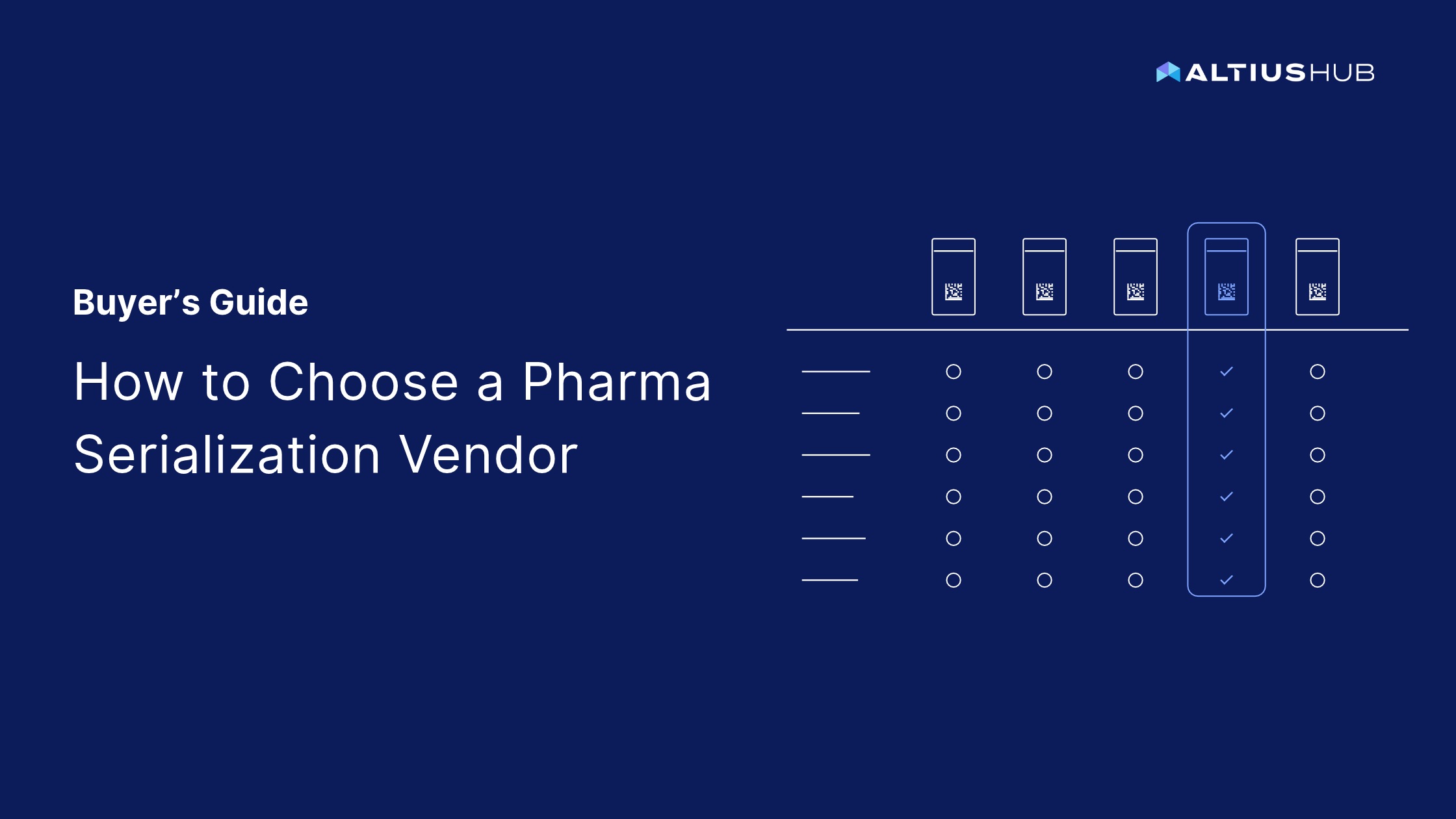
How to Choose a Pharma Serialization Vendor: A Buyer’s Guide for Manufacturers
A serialization platform holds your serial number records, reports to regulators where required, and exchanges data with your trading partners, often for many years. Choosing one comes down to understanding the kinds of platform on offer and comparing vendors on six factors: which markets are really live, what the platform covers, how partners and plant systems connect, how errors are caught, how easy the platform is to use and support, and how long it takes to go live and what it costs. This guide goes through each, then looks at how a move from one vendor to another is usually planned. It is written by AltiusHub, a cloud-based serialization platform for pharmaceutical manufacturers, and says where AltiusHub fits at the end.
Start With Your Own Operation
Five facts about your operation shape the choice more than any feature list:
- The markets you report to today, and those you expect to add over the next three years.
- The number of manufacturing sites, and how many serial numbers you produce each year.
- The ERP and the line-level systems already in place.
- Your trading partners, from contract manufacturers and logistics providers to distributors and wholesalers, and how each exchanges data with you today.
- Who owns validation, and when you need to be live.
Five Kinds of Serialization Platform
Serialization software is built in several ways, and the way it is built decides who it suits. Five kinds are in common use, and some vendors blend more than one. Two terms are useful here. L4 is the company-level layer of software that holds serial number records and manages commissioning, the step that marks a serial number as in use. L5 is the layer that exchanges serialization data with trading partners and regulators.
Network-based platforms connect trading partners through a shared network run by the vendor. They work well for a company whose partners are already on that network, and for one that wants supply chain functions beyond serialization in the same place. The cost of such a platform depends on how its fees grow as markets are added.
ERP-embedded platforms run inside the manufacturer’s own ERP system. They fit companies that have standardized on one ERP and have the skills to run it, in house or through an implementation partner. Reports and support then follow that ERP’s tools and release schedule.
Equipment-group platforms come from a company that also builds packaging line equipment. They suit manufacturers who buy lines and software together and want one supplier accountable for both. How well they work with line systems from other makers is the question for plants with mixed equipment.
Supply-chain-wide platforms are built for everyone in the chain: manufacturers, wholesalers, logistics providers and dispensers. Many grew out of the rules of one market, such as the US Drug Supply Chain Security Act (DSCSA). They suit organizations that need to exchange data with the whole chain on one platform, though a manufacturer may use only part of what is offered.
Cloud-native L4 and L5 platforms are built for manufacturers that report to many markets from one cloud instance. AltiusHub is an example. They suit manufacturers whose main need is serialization compliance across several markets, and they rely on partners connecting to the platform itself.
Six Factors to Compare Between Vendors
Whatever kind of platform you are looking at, the same six factors separate a good fit from a poor one.
1. Which markets are really live
Every vendor publishes a list of supported markets, but a list does not show whether anyone is using the platform there. The better number is how many customers are in live production, meaning customers whose real shipments are reported through the platform and not ones still testing, in each market you care about. Regulations also change. Who writes and applies the update, how much notice customers get and whether updates cost extra all affect how smooth life is after go-live.
2. What the platform covers, and how it handles data
A platform may manage serial number records and regulatory reporting yet leave label printing, line control or master data (the product, pack and location records) to other systems. It is worth knowing where its job ends and who connects the pieces. The same goes for data exchange. Serialization events travel in a standard format called EPCIS, and platforms differ in which versions they accept and in what they do with an event that arrives malformed: reject it, hold it for manual repair, or accept it and flag it.
3. How partners and plant systems connect
There are two sets of connections. For trading partners, what counts is how each main partner would exchange data with the platform, who does the technical work and how long adding a partner usually takes. For plant and ERP systems, vendors often promise integration “out of the box,” meaning it works with standard settings and no custom code. The proof is the list of line systems and ERPs where that is true today, how much effort the latest integration took and who carried it out.
4. How errors are caught
Validation has two sides. One is the platform’s ability to catch bad data, such as a duplicate serial number or an event recorded out of sequence, before it reaches a regulator. The other is the paperwork behind the software itself: its validation package and the inspection history of the customers who rely on it.
5. How easy it is to use, and what support looks like
A platform that operators learn quickly produces fewer errors and costs less to train for, and a short trial with your own team is the most direct way to see this. Support comes down to hours, channels, the response times written into the contract and who is responsible when an implementation partner is involved. A vendor’s stability is best judged through references from manufacturers of a similar size.
6. How long it takes to go live, and what it costs
Time to go live depends on the number of markets, sites and partners and on how ready your data is, so a range based on a customer of similar size, with its assumptions, says more than a single figure. Pricing can be built on countries, sites, serial numbers or events, and vendors have sound reasons for their choices. Quotes only compare fairly when they cover the same markets and volumes, today and as planned, and state what is left out, such as extra markets, validation support, partner onboarding and support.
Reading the Numbers Vendors Publish
Customer counts, market counts and serial number totals are useful, but a few details decide how far a figure can be trusted. The date comes first: a customer count from a few years ago may be out of date. Then what is counted. Customers can mean companies, sites or contracts, and markets can mean those with live customers or every market with any support at all. Words such as “largest” or “fastest” mean little without a stated measure and a stated group of competitors. And when one document gives two totals for the same thing, the usual cause is two ways of counting.
Moving to a New Vendor
A move rarely happens in one step, and the order depends on your markets and partners. Most plans start by listing every market you report to, every partner you exchange data with and how each connects today. Next comes the transfer of serial number records and history, where both vendors can describe the formats and what can be imported. Partners then need to start receiving data from the new system. Many manufacturers agree an order with each partner, test each connection and keep the existing one running until the new one is confirmed.
Two more pieces need their own plan. Event history has to stay available, so that a regulator’s question about a batch shipped before the move can still be answered, and the new system needs its own validation before the switch date. Moving one market or site at a time keeps any problem small, and the notice period, data return terms and minimum commitments in the current contract usually set the earliest date.
Where AltiusHub Fits
AltiusHub is a cloud-based serialization, track-and-trace and compliance platform for pharmaceutical manufacturers, and it works at L4 and L5. It supports more than 50 regulated markets, including US DSCSA, EU FMD, UAE Tatmeen and Saudi RSD, from one cloud instance, and regulatory changes are applied to the platform centrally. Each trading partner connects to AltiusHub directly, and the team works with the manufacturer on how partners are brought across. More than 20 regulatory audits have been completed with zero compliance failures, 35 manufacturing sites are live, and more than one billion units were tracked in the last 12 months. For a manufacturer comparing vendors, the AltiusHub team can go through the six factors with you against its own markets and volumes.


Meanwhile, read our top resources